
Playing card games for real stakes has shifted from smoky casino rooms to digital platforms accessible from any device. Thousands of players across Turkey and worldwide now enjoy competitive poker sessions without leaving home. Modern platforms, including lux casino, host cash games, tournaments, and free practice tables around the clock. This guide covers everything from basic hand rankings to advanced bankroll strategies, helping you start your online poker journey with confidence and knowledge.
What Is Online Poker?
Online poker replicates traditional card games through software platforms that connect players globally. You compete against real opponents rather than algorithms, while the site acts as dealer and rake collector. Major platforms like PokerStars, GGPoker, and Ignition Casino offer Texas Hold’em, Omaha, and specialty variants with stakes ranging from $0.01/$0.02 to professional high-roller tables.
The core difference from live poker lies in speed and accessibility. Digital tables shuffle instantly, deal cards within seconds, and allow multi-tabling across multiple games simultaneously. Players from Turkey access international rooms alongside locals, creating diverse competition pools. Software tracks statistics, hand histories, and player notes automatically—tools unavailable in brick-and-mortar venues.
Welcome bonuses provide starting value: PokerStars delivers a 100% deposit match up to $600 with code STARS600, while GGPoker matches deposits up to $600 for new accounts. Ignition Casino offers crypto users a 100% bonus up to $1,500, or $1,000 via traditional banking methods. These promotions require wagering through specific playthrough requirements before withdrawal.
How Online Poker Games Work
Registration takes minutes—create an account, verify your email, and deposit funds using credit cards, e-wallets, or cryptocurrency. Most platforms require identity verification for withdrawals, typically a photo ID and proof of address. Turkish players commonly use Visa, Mastercard, Skrill, Neteller, or Bitcoin depending on the site’s payment infrastructure.
After funding your account, select a game format and stake level from the lobby. Cash game tables display current player counts, average pot sizes, and hands per hour. Tournament listings show buy-ins, prize pools, and start times. Sit & Go events begin immediately when enough players register, offering fixed prize structures without scheduled start times.
The software assigns seats randomly, deals cards face-down to each player, and rotates the dealer button clockwise after every hand. Action proceeds automatically with timer bars indicating your decision window—typically 30 seconds for cash games, longer for tournament play. Chat functions, emotes, and customizable avatars add social elements to the digital experience.
Basic Poker Rules and Hand Rankings
Texas Hold’em, the most popular variant globally, deals two private cards to each player plus five community cards revealed in stages. You combine any five cards to form your best hand.
Omaha follows similar structure but deals four private cards, requiring exactly two from your hand and three from the board.
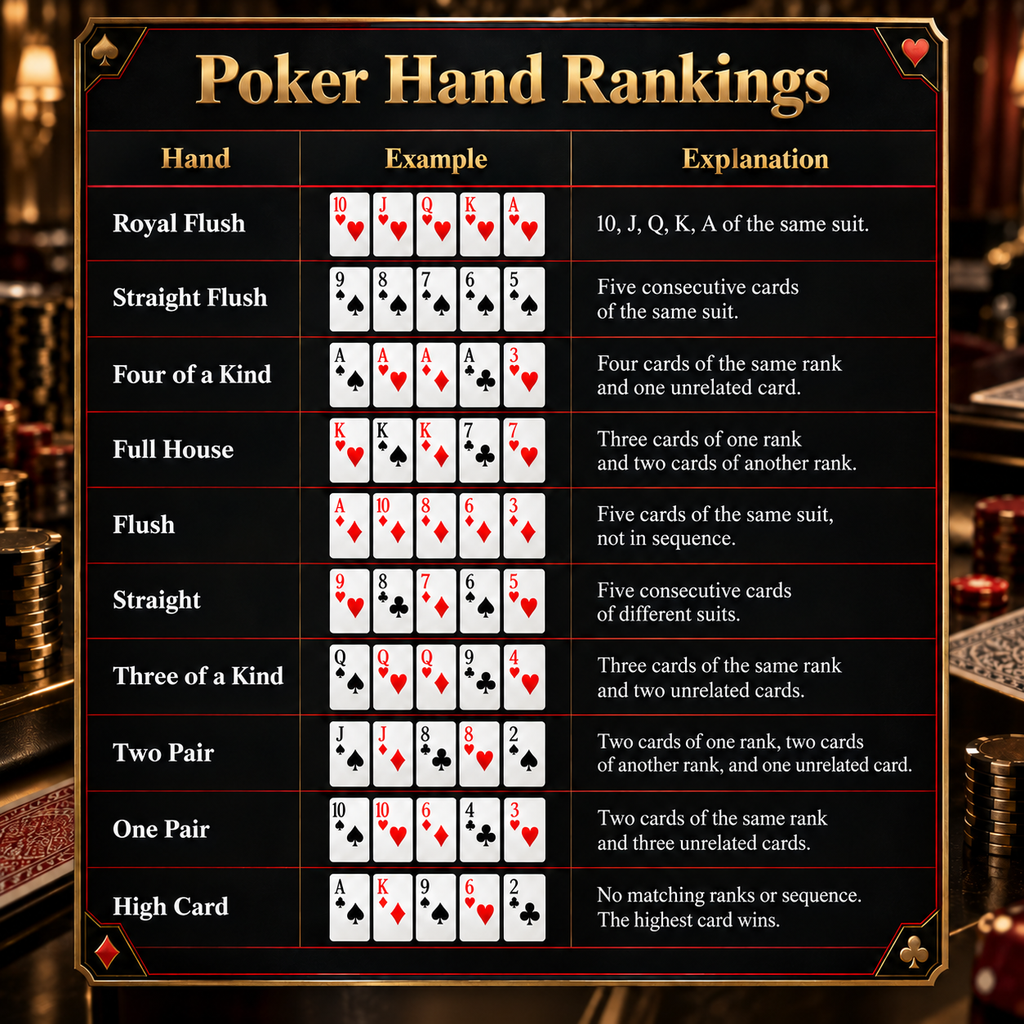
Hand rankings from highest to lowest: Royal Flush (A-K-Q-J-10 suited), Straight Flush (five consecutive suited cards), Four of a Kind, Full House (three of a kind plus pair), Flush (five suited cards), Straight (five consecutive ranks), Three of a Kind, Two Pair, One Pair, High Card. Suits hold no rank value—only card faces determine winners in showdowns.
Winning requires either the best five-card combination at showdown or forcing all opponents to fold through betting pressure. Position matters significantly: acting last provides informational advantage since you observe opponents’ decisions before making yours. The dealer button position rotates clockwise, ensuring fairness over extended sessions.
How to Choose a Poker Game and Table
Beginners should start with micro-stakes cash games—$0.01/$0.02 or $0.02/$0.05 blinds—to learn mechanics without risking significant bankroll. Play poker online free in practice mode first if available, mastering interface navigation and betting controls. Most platforms offer play-money tables where chips have no cash value, ideal for experimenting with strategies risk-free.
Texas Hold’em provides the simplest learning curve with abundant educational resources available. Omaha introduces complexity through four-card hands and pot-limit betting, suitable after mastering Hold’em fundamentals. Avoid exotic variants like Razz or Stud until comfortable with standard formats—these require specialized knowledge rarely found in mainstream guides.
Table selection impacts win rates dramatically. Look for tables with high average pot sizes relative to blinds, indicating loose recreational players. Avoid tables filled with regulars grinding multiple sessions daily—their experience and software tools provide substantial edges. Filter lobby options by statistics: seek tables averaging 30%+ players seeing the flop, signaling softer competition.
Cash Games, Tournaments, and Sit & Go Formats
Cash games exchange chips for real currency at fixed rates, allowing entry and exit anytime. Blinds remain constant throughout your session, and you can rebuy chips after losing your stack. This format suits players preferring flexible session lengths and direct bankroll correlation. Rake typically reaches 5% of each pot up to a $3 cap at micro-stakes.
Tournaments charge a fixed buy-in ($10+$1 format shows $10 prize pool contribution, $1 site fee) and distribute prizes to top finishers—typically 10-15% of the field. Blinds increase at scheduled intervals, forcing action as stacks shrink relative to betting costs. Deep runs can last hours, requiring endurance and adaptable strategies. Poker online tournament lobbies display structures, blind schedules, and late registration periods upfront.
Sit & Go events combine elements of both: fixed buy-ins like tournaments but starting immediately when tables fill (usually 6 or 9 players). Prize structures typically pay top three spots in single-table formats. These conclude within 30-60 minutes, offering tournament experience without extensive time commitments. BetRivers Poker hosts regular Sit & Go schedules with $1 to $100+ buy-ins across skill levels.
Blinds, Betting Rounds, and Player Actions
Small and big blinds force action by requiring mandatory bets before cards appear. In a $0.50/$1 game, the small blind posts $0.50, the big blind posts $1, and action begins with the player left of the big blind. This rotation ensures every player contributes equally over time.
Four betting rounds structure each hand: preflop (before community cards), flop (after first three community cards), turn (after fourth card), and river (after fifth card). Available actions include fold (discard hand), check (pass action without betting), call (match current bet), raise (increase bet size), or all-in (commit remaining chips).
Bet sizing carries strategic weight—small bets invite calls, large bets narrow opponent ranges to strong hands only. Minimum raises typically double the previous bet amount. Pot-limit structures cap raises at current pot size, while no-limit allows any amount up to your stack. Software prevents string betting and enforces legal action sequences automatically, eliminating common live-game errors.
Starting Hands and Table Position
Premium starting hands include pocket pairs (A-A through Q-Q), suited big cards (A-K, A-Q, K-Q suited), and strong offsuit combinations (A-K, A-Q). These hold value from any position and warrant raises preflop. Medium pairs (J-J through 7-7) and suited connectors (10-9s, 9-8s) play profitably from later positions where fewer opponents remain to act.
Early position demands tighter hand selection—fold rates should exceed 80% from seats immediately left of blinds. Middle position allows modest expansion, adding suited connectors and medium pairs. Late position (button and cutoff seats) enables profitable play with hands like small pairs, suited aces, and any broadway combination (cards 10 through A).
Position dictates post-flop profitability more than card strength alone. Acting last on all streets allows information-gathering before committing chips, while early position forces decisions with incomplete data. Adjust starting ranges accordingly: play 15% of hands from early position, 20% from middle, and 30-40% from late position and button.
Basic Strategy for Beginners
Tight-aggressive play forms the foundation of winning poker: enter pots with strong hands, then bet and raise rather than checking and calling. This approach builds pots when ahead and avoids costly confrontations with marginal holdings. Fold rates of 70-75% at micro-stakes indicate disciplined hand selection.
Continuation betting captures pots when opponents miss flops—bet 50-70% pot size as the preflop raiser approximately 60% of the time. However, recognize when boards favor opponents’ ranges and check instead. Avoid bluffing excessively at low stakes where players call frequently—value betting strong hands generates most profit against recreational opponents.
Observe opponent patterns: tight players fold often and hold strong ranges when active, loose players enter many pots with weak holdings. Aggressive opponents bet frequently regardless of strength, passive opponents check and call with made hands. Adjust by value-betting lighter against calling stations, bluffing more against tight folders, and check-raising aggressive opponents with strong hands.
Bankroll Management in Online Poker
Professional bankroll guidelines recommend 20-30 buy-ins for cash games (full stack amounts), 50-100 buy-ins for Sit & Go events, and 100-200 buy-ins for multi-table tournaments. A $500 bankroll supports $0.25/$0.50 cash games (100 big blinds = $50 buy-in), $5 Sit & Go events, or $2.50 tournament entries.
Move down stakes immediately after losing 25% of your bankroll. Emotional decision-making—called “tilt”—destroys bankrolls faster than skill gaps. Set stop-loss limits per session (10-20% of total bankroll) and quit when reached, regardless of session duration. Winning streaks tempt stake jumps, but sustainable growth requires patience and proven win rates before advancing.
Track results in dedicated software or spreadsheets, recording stakes, format, session length, and profit/loss. Calculate win rates per 100 hands for cash games or ROI (return on investment) for tournaments. Consistent winners at one stake level demonstrate readiness to advance—aim for 5+ big blinds per 100 hands in cash games or 10%+ ROI in tournaments over 10,000+ hands before moving up.
Account Security and Responsible Play
Enable two-factor authentication on poker accounts to prevent unauthorized access. Use unique passwords combining letters, numbers, and symbols—never recycle passwords from email or banking accounts. Reputable platforms employ SSL encryption and segregated player funds, but individual account security remains your responsibility.
Set deposit limits within account settings to control spending—most sites enforce daily, weekly, or monthly caps upon request. Reality check features display session duration at regular intervals, combating time distortion during extended play. Self-exclusion tools allow temporary or permanent account closure if gambling becomes problematic.
Online poker is restricted to players aged 18 or older in most jurisdictions. Underage gambling carries legal consequences and risks account seizure with forfeited funds. Recognize warning signs of problem gambling: chasing losses, hiding play from family, neglecting responsibilities, or betting amounts beyond entertainment budgets. Resources like BeGambleAware and GamCare offer confidential support for players or family members concerned about gambling behavior.
FAQ
Is online poker legal in Turkey?
Turkey’s gambling laws prohibit most forms of online betting, including poker for real money. International platforms operate outside Turkish jurisdiction and may be inaccessible via some internet service providers. Players should review local regulations and understand legal risks before registering or depositing funds on offshore poker sites.
What is the best starting bonus for online poker in 2026?
Ignition Casino offers the highest match rate at 100% up to $1,500 for cryptocurrency deposits or $1,000 via traditional banking. PokerStars provides a 100% up to $600 bonus using code STARS600, while GGPoker matches first deposits up to $600. Bonus value depends on playthrough requirements and release structures—compare wagering terms before claiming any promotion.
Can I play poker online free without depositing?
Most major platforms offer play-money tables where chips carry no cash value, allowing unlimited practice without financial risk. 888poker provides a no-deposit $20 bonus to new registrants, usable in real-money games after account creation. Free-roll tournaments—events with no entry fee and real prize pools—run daily on sites like PokerStars and ACR Poker, offering prize money without initial investment.
How long does it take to withdraw winnings from poker sites?
Processing times vary by payment method and platform. E-wallets like Skrill and Neteller typically process within 24 hours after approval. Credit card withdrawals may take 3-5 business days. Cryptocurrency withdrawals often complete within hours. Initial withdrawals require identity verification, adding 24-48 hours to the process. Sites like Ignition Casino prioritize fast payouts as a competitive advantage, advertising same-day processing for crypto users.
What poker variant should beginners learn first?
Texas Hold’em No-Limit offers the best learning environment due to abundant educational content, largest player pools, and straightforward rules. Master Hold’em fundamentals before exploring Omaha, which requires calculating four-card hand combinations and pot-limit betting nuances. Tournament and cash game formats both suit beginners—choose based on preferred session length and bankroll flexibility.
How much money do I need to start playing online poker?
Micro-stakes players can begin with $50-$100, supporting 20-30 buy-ins at $0.01/$0.02 cash games or $1 Sit & Go events. Comfortable learning bankrolls of $200-$300 allow stake experimentation without reload pressure. Deposit bonuses stretch initial funds—a $100 deposit on PokerStars with the STARS600 code adds $100 in bonus funds released through play, effectively doubling your starting bankroll.
Do poker sites use rigged algorithms or bots?
Licensed platforms employ certified random number generators audited by independent testing agencies like eCOGRA and iTech Labs. Card distribution is provably random over large sample sizes. However, bot accounts operated by third parties exist on some platforms—reputable sites actively detect and ban bots through behavioral analysis and player reports. Choose established brands with strong security reputations and regulatory oversight to minimize bot exposure.